
Guide to Missouri Divorce Records
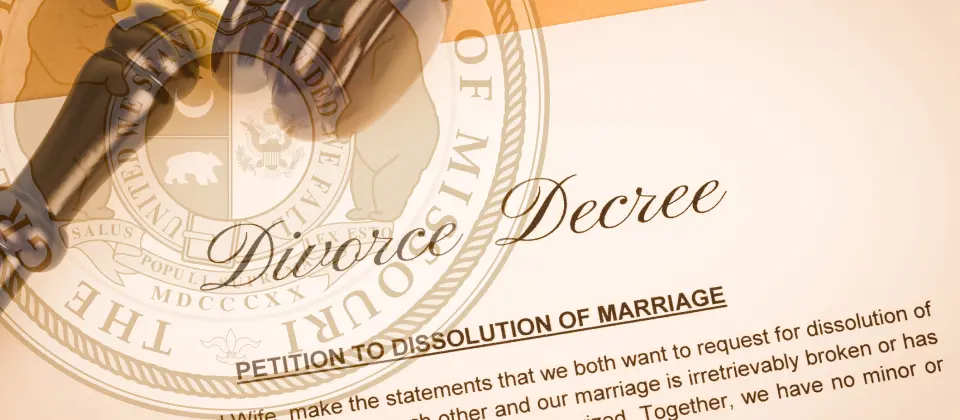
Divorce laws and rules for accessing records vary by state. In Missouri, divorce records are public and can be viewed or copied by anyone.
Missouri divorce records contain all the legal documents made during a divorce case in the state. The Circuit Courts create and keep these records.
In Missouri, divorce records are used for both administrative tasks, such as issuing new marriage licenses, and legal functions, such as transferring property ownership after divorce.
A Missouri divorce record contains the following information:
The full names of the parties in the divorce
The county and circuit court location where the divorce was granted
Date the divorce was finalized or granted
Divorce case number
The court's ruling on property division, debt allocation, alimony, and child custody/support
You can obtain Missouri divorce records online and offline. Most recent records are available online through the Missouri Casenet Portal. You can search records by name, case number, and filing date. Older records are generally maintained in physical formats such as paper files and microfilm.
The contents of each Missouri divorce are determined by the circumstances of the case. If a divorce case involves minor children, the record must clearly state the court's decision on legal custody, parenting time, and child support. Understanding how divorce is handled in the state provides insight into what information is likely to appear in a divorce record and how to access those records.
Where are Missouri Divorce Records Stored?

Missouri divorce records are maintained at the county and state levels. County-level records include divorce decrees and case files maintained by the Circuit Court in the county where the divorce was finalized. You can access records through the Circuit Court Clerk's Office where the case was handled.
At the state level, divorce records are maintained by the Department of Health and Senior Services and issued through the Bureau of Vital Records. These records serve as official confirmation that a divorce occurred.
Is Missouri a 50/50 Divorce State
Under Missouri law, judges are required to distribute marital property and debt acquired during a marriage in a manner that is fair and reasonable. This means Missouri is not a community property state in which marital property is shared equally.
To ensure equitable distribution of property, the judge looks at the following factors:
Duration of the Marriage - In a property division proceeding, the court considers the length of the marriage. If the marriage is short, the court may distribute property so that each person keeps more of what they brought into the marriage.
Income and Earning Capacity - Courts consider each person's current income and future earning capacity. If one spouse cannot support themselves, they might get a bigger share of the marital property to help them financially.
Contributions of Each Spouse - Missouri law requires judges to consider each party's contribution to the acquisition, maintenance, and growth of marital property during divorce. If a party's action or efforts directly or indirectly influence the maintenance and growth of marital property, they may receive a larger share of the property. Contribution to marital property may include money, homemaking, childcare, or supporting the other's career.
Types of Missouri Divorce Records

Missouri divorce includes divorce certificates, divorce decrees, and divorce case files. These records are used for specific administrative or legal functions.
For example, a divorce certificate is usually required as proof that users can legally remarry. It may also be used to change their name or in applications for a new marriage license. On the other hand, a divorce decree is used to enforce a court's decision on child support or property. It provides a legal basis for holding a person's former spouse in contempt of court for failing to comply with any order the court made in the case.
Lastly, if users want to see the full record of a divorce case, they can request the divorce case file. This file provides a legal history for enforcing or modifying the terms of a divorce.
Missouri Divorce Certificate (Certificate of Divorce)
A certificate of dissolution is a single-page document that confirms the termination of a marriage. This document typically includes the names of both spouses, the county where the divorce was granted, and the date of the divorce. Certificates of dissolution are issued by the Bureau of Vital Records.
Divorce Decree (Final Judgment of Divorce)
A Missouri divorce decree is the final court order that legally dissolves the marriage and records all judicial decisions made during the case. Once signed by a judge and filed, it is legally enforceable against both spouses.
The Circuit Court in the county where the divorce was filed issues the divorce decree. A Missouri divorce decree typically contains the following rulings:
Property and Debt Division - The divorce decree specifies the allocation of marital assets and liabilities.
Alimony - Provides information on spousal support, including payment terms and duration.
Child Custody and Support - If the couple has a child under 18, the divorce decree will include details of child custody arrangement, visitation, and support.
Final Judgment Date - Shows the date the judge signed the decree, which is when the marriage officially ends.
Divorce Case File
A divorce case file contains all documents filed with the Circuit Court Clerk from start to finish. It includes the initial complaint, summons, responses, motions, temporary orders, financial statements, parenting plans, and the final decree. Unlike the divorce decree, which is a binding order, the case file is a complete record of everything that happened in the case.
You can access divorce case files at the Circuit Court in the county where the divorce was filed, usually by visiting the courthouse in person.
How to File for Divorce in Missouri (Step-by-Step)
Before filing for a divorce in Missouri, it is always a good idea to confirm whether there are residency requirements and if you meet the requirements. Like most states, Missouri has a mandatory residency requirement for anyone seeking dissolution of marriage.
You can only file for divorce in the state if you or your spouse has lived in the state for at least ninety days before filing. The rule applies equally to military personnel stationed in Missouri.
In addition to residency requirements, you must also understand that dissolution of marriage can be contested or uncontested. This distinction determines the overall cost, complexity, and timeline of the proceedings.
Uncontested Divorce - A dissolution of marriage is uncontested when both parties reach an agreement on all issues and file supporting documentation with the court. This type of case generally involves fewer court appearances and incurs lower costs than contested proceedings. They also afford the parties greater control in determining outcomes related to their assets and children.
Contested Divorce - A contested dissolution occurs when the parties cannot agree on one or more issues, such as custody, alimony, or property division. In such cases, the court determines the outcome of the divorce through discovery, hearings, mediation, and trial.
If you meet Missouri's residency requirement, you may proceed with the filing steps outlined below.
Step-by-Step Divorce Process
Missouri divorce cases are subject to local rules that vary by judicial circuit. You can contact the Circuit Court Clerk in the county where you plan to file to confirm what is applicable in court. The process depends on whether the divorce is contested or uncontested.
Prepare the Filing Packet
To begin a divorce case in Missouri, you must first gather and complete the legal documents required by the Circuit Court. These documents must be properly organized and filed to officially start the dissolution of the marriage.
Identify the Divorce Path (1A vs. 1B) - This is where you decide if the divorce will be contested or uncontested.
Prepare the Required Documents - Assemble the following documents:
Complaint for Dissolution of Marriage - Filing a complaint of dissolution form officially begins a case. In this form, you must provide basic information about the marriage and state the relief you are requesting.
Certificate of Dissolution of Marriage - Missouri law requires the submission of a completed Vital Statistics Certificate of Dissolution of Marriage. You must download, complete, and bring the certificate with you when filing the complaint.
Statement of Property and Debt - This form helps you list your assets and liabilities.
Statement of Income and Expenses - This provides details of your personal income, deductions, and monthly expenses.
Confidential Case Filing Information Sheet - A confidential case filing information sheet is used to submit personal identifiers such as Social Security numbers, birth dates, and employer information.
Any other form required is determined by the type of divorce you are filing. You can access divorce forms through your local court website or office.
Filing Fees and Fee Waivers - The cost of filing for divorce in Missouri varies by county. People can contact the Circuit Court Clerk in the county of filing for the fee schedule. If they cannot afford to pay the filing fee because they have a very low income, individuals can ask the judge to waive the filing fee.
File the Case
After gathering your paperwork and preparing the applicable filing fee, you can take the following steps to file the case:
Where to File - The Circuit Court in the county where either spouse resides is the appropriate venue for filing a dissolution of marriage.
Filing Methods - You can file in person at the clerk's office, by mail if allowed, or electronically in counties that support eFiling. Electronic filing may be done by fax or email, depending on local rules:
In person - Visit the Circuit Court Clerk's office to submit documents and fees.
Mail - If the county Circuit Court Clerk's Office allows mail-in submission, submit the appropriate forms and proof of filing fee payment by mail.
Electronic Filing (eFiling) - Several Missouri counties now offer eFiling for divorce cases. In some counties, you can file electronically by fax or email. Check with the clerk or local rules to see if this option is available.
What You Receive - After filing the required paperwork, you will receive the following from the Circuit Court Clerk:
A case number to help you track the divorce case
Summons if the divorce is a contested case
Initial court notices or scheduling information
Service of Process (Primarily for Contested Cases)
Under Missouri law, you are required to notify your spouse that a complaint for dissolution of marriage was filed against them. Common methods of service in Missouri include:
Waiver of Personal Service: This method works best when users and their spouses agree to dissolve the marriage. It requires individuals to deliver the documents to their spouses. Each spouse is expected to acknowledge the petition and execute an “Entry of Appearance and Waiver of Service.”
Personal Service: In contested cases, people may serve their spouse using a sheriff deputy or other authorized officer. The sheriff or authorized officer will deliver the petition and summons directly to each spouse. Users must provide the court with precise information regarding their spouse's location and availability to facilitate service.
Private or Special Process Server: If your spouse is avoiding service or can not be found, you may hire a private server to deliver the documents. An attorney can guide you through this process.
Service by Publication: To use this method, you must first get approval from the court. Service by publication is allowed when all reasonable efforts to locate your spouse have been exhausted. This method allows you to complete the service by publishing notices about the case in newspapers.
Early Case Phase and Temporary Orders
Missouri courts seek to maintain the status quo during the early phase. Discovery is a key process at this stage and often results in temporary orders. During this period, both spouses may take actions to address present concerns, including:
Exchanging relevant information, such as financial documents. This will help everyone understand the scope of the divorce case.
Filing a motion requesting a temporary order where issues like child care or financial needs arise.
Gathering evidence to show the court you need temporary relief.
After mediation, the judge may hold a hearing to determine whether to issue temporary orders, which may include:
Temporary child or spousal support
Exclusive use of marital property, such as the marital home
Child custody and visitation arrangements
Restraining or protective orders when safety is a concern
Financial Disclosures and Discovery
In Missouri, both parties are required to provide full and honest financial statements during a divorce. Here are the key parts of financial discovery in a Missouri divorce:
Mandatory Disclosure - During a divorce proceeding in Missouri, you and your spouse must file both statements of income and expenses, and a statement of property and debt. The statement of income and expenses will provide details of income sources, pay stubs, and monthly expenses for both the parent and children. On the other hand, the statement of property and debt lists everything you own and owe, and marks them as marital or separate property.
Discovery Tools - In contested Missouri divorce proceedings, several discovery tools may be used to obtain information necessary to determine alimony, property division, and related issues. These include:
Request Documents - You can ask your spouse for copies of financial records, such as tax returns and pay stubs.
Interrogatories - Written questions requiring sworn responses concerning financial matters and other relevant case details.
Subpoenas - Legal instruments compelling third parties, such as banks, employers, or retirement plan administrators, to provide financial information.
Case Management and Court Conferences
In Missouri, a court may order a case management conference before a final hearing. A case management conference is an early, court-mandated meeting involving the judge, the parties, and their counsel in contested matters. Its purpose is to create a plan to move the case forward. It also sets deadlines and explains what the court expects from both parties before the hearing.
At this stage, the judge expects full disclosure, and that settlement discussions have started. If these expectations are not met, the following actions may take place at the pretrial conference:
The judge reviews the progress made by both parties in providing financial statements.
The court also clarifies contested issues regarding any established terms.
Deadlines are established for discovery and any needed depositions.
Mediation may be ordered to help resolve complex matters, such as child custody.
Temporary orders may be issued to cover urgent issues such as alimony, use of the marital home, and temporary child support.
Settlement or Trial
Missouri divorce cases are resolved through settlement or trial. Settling allows spouses to reach their own agreement rather than leaving everything to the judge. Settlement options include:
Signing a marital settlement agreement
Discussing directly with your spouse
Participating in mediation with a neutral facilitator
Attorney-led settlement discussions
If a settlement cannot be reached, the divorce case will proceed to trial. At trial, each party must present evidence to prove its case. After hearing all the evidence, the judge issues a ruling. The ruling becomes the final judgment in the case.
Judgment, Waiting Periods, and Finalization
Missouri has a mandatory waiting period in a divorce case:
The 30-Day Waiting Period - Missouri has a 30-day waiting period between when you file for divorce and when it can be finalized. You can use this time to gather financial documents, create a parenting plan, and prepare your budget for after the divorce.
Child Custody and Child Support in Missouri Divorces
When a divorce involves a minor child, the court's main focus is the child's stability and well-being. Custody and child support are handled separately from property issues.
Missouri courts decide custody based on what is in the child's best interests. The law assumes that equal or nearly equal parenting time is best for the child. However, the court may award one spouse more parenting time if they can prove that equal parenting time is not in the child's best interests. In making custody decisions, the court will consider the following factors:
The wishes of the child's parents regarding custody and the proposed parenting plan submitted by both parties
The needs of the child for a healthy and meaningful relationship with both parents
The emotional relationship between the child and the parent
The mental and physical health of each parent
Legal Custody vs. Physical Custody
Child custody may take the form of legal custody, physical custody, or both, and these may be shared by the parents depending on the circumstances of the case.
The court may award joint custody when both parents submit a parenting plan, and the court finds it to be in the child's best interests.
Alternatively, the court may also order joint custody after a hearing if it independently determines that joint legal custody, joint physical custody, or both, serve the best interests of the child.
Legal Custody - This gives a parent the authority to make major decisions about the child's education, healthcare, religious upbringing, and overall welfare.
Physical Custody - This concerns where the child lives and who cares for them daily. Physical custody may be shared between parents or awarded to one parent. The court makes the decision by considering the child's needs.
Child Support Guidelines and Enforcement
In Missouri, both parents are required to pay child support. The court determines the appropriate amount using state-approved guidelines:
Both parents' incomes
The number of minor children involved
Child expenses
After a court issues a child support order, the payments are legally enforceable. Missouri courts use several methods to enforce child support payments. These enforcement options include:
Driver's license or professional license suspension
Wage withholding (automatic deduction from paycheck)
Interception of federal and state tax refunds
Property, Debt, and Alimony in Missouri Divorces
Under Missouri law, the court must decide how to divide marital assets and debts, and whether to award alimony, during a divorce proceeding.
If the spouses agree on how to divide their property, the court will generally accept the agreement. However, such an agreement must be reached fairly and must not harm either party. The court also considers the interests of any children when reviewing such agreements.
If no agreement is reached, the court must decide how to divide the marital property equitably. Both spouses are required to present evidence about their property, and the court determines which assets are marital and which are separate.
In Missouri, marital property refers to all income and assets acquired by either spouse during the marriage.
Separate property includes assets owned before marriage or received individually as gifts or inheritance.
The court must also consider debts when dividing property. Marital debt includes obligations incurred during the marriage for the joint benefit of both spouses. In distributing marital debt, the judge looks at the following factors:
Each party's ability to repay the debt
The spouse who incurred the debt, and for what purpose
Whether only one party or both spouses (or the marriage) benefited from the debt
The overall distribution of marital property
In Missouri, alimony may be awarded to provide temporary financial support while a spouse is out of the workforce or completing education needed for employment.
Common types of alimony in the state include:
Temporary Alimony: Provides short-term financial support while the divorce is pending. It helps a spouse meet immediate living expenses.
Permanent Alimony - A fixed amount of support paid all at once or over a fixed timeframe after the divorce is finalized.
Errors, Omissions, and Corrections in Missouri Divorce Records
Missouri divorce records may contain mistakes, such as incorrect dates, misspelled names, missing details, or other errors that can affect the document's authenticity. If your Missouri divorce record contains an error, it is always best to correct the error promptly.
You can correct an error on a divorce certificate by submitting a request for an amendment to the Missouri Bureau of Vital Records. Your request must provide the full names of the parties in the divorce and the date the divorce was granted. It must also specify that items are incorrect or missing.
After receiving your request, the Bureau will issue a correction affidavit with instructions and the documentation required to support the correction. Major corrections in vital records must be resolved through a court order. In such cases, the Bureau must receive a certified copy of an order from a court of competent jurisdiction detailing the changes and identifying the record as it currently appears.
To correct a divorce decree, you must file a motion to correct clerical mistakes or amend a judgment with the Circuit Court that issued the final judgment. The judge will review the request and determine whether the correction is appropriate.
After the court approves the correction, you may request updated copies of the certificate or decree from the relevant office:
Obtain your updated divorce certificate from the Bureau of Vital Records.
Get your updated Missouri divorce decree from the Circuit Court Clerk's Office in the county where the divorce was finalized and the decree updated.
How to Access Missouri Divorce Records

You can access Missouri divorce records online, in person, and by mail.
Online Access
Divorce Decrees - Missouri Circuit Courts do not issue divorce decrees online. You may visit the courthouse to view the decree or request a copy by mail.
Divorce Certificates - Missouri divorce certificates can be ordered from the Bureau of Vital Records through VitalChek. Each certified copy costs $15.
In-Person Request
Divorce Decrees - In Missouri, the Circuit Clerk's Office in the county where the divorce is granted maintains divorce decrees. To obtain a copy of a final divorce judgment, you must visit the Circuit Court Clerk's Office in the county where the case was filed and finalized.
Divorce Certificates - To request a Missouri divorce certificate in person, complete the application form and call the Bureau of Vital Records at (573) 751-6387 to schedule an appointment. To complete your record request, you will need to provide valid identification as specified on the form and pay the required fee.
Mail-in Request
Divorce Decrees - Contact the Circuit Court Clerk's Office in the county where the divorce was finalized to find out if they offer mail-in services for full divorce decree requests.
Divorce Certificates - To get a divorce certificate application by mail, send an application form with a $15.00 check or money order made out to Vital Records:
Missouri Department of Health and Senior Services- Bureau of Vital Records, 930 Wildwood Drive, Jefferson City, MO 65109
In Missouri, vital records are not open to everyone. Only the people directly involved in the divorce and their authorized representatives can receive copies of these records.
Missouri Courthouses That Handle Divorces
When starting a divorce in Missouri or trying to locate divorce records, it is a good idea to know which court handles these cases and where to file. Divorce cases are handled by a specific level of the state court system.
Court Authority for Missouri Divorce Cases
Missouri Circuit Courts handle divorce cases and all related family law matters. In some larger counties, there are special Family Court Divisions that handle divorce cases.
County-Based Filing
Court records in Missouri are maintained at the county level. As such, it is always good to know which county has jurisdiction when filing a divorce case or requesting a copy of a divorce decree. In Missouri, you can file for divorce in the county where either spouse lives.
On the other hand, divorce certificates are issued by the Missouri Bureau of Vital Records. Here are places to find final divorce decrees for some popular Missouri counties:
Jackson County Courthouse - Jackson County Circuit Court
Cole County Courthouse - Cole County Circuit Court
Buchanan County Courthouse - Buchanan County Circuit Court
St. Louis County - St. Louis County Circuit Court
Jurisdiction Basics
In Missouri, circuit courts handle divorce and related civil cases. At least one spouse must have lived in Missouri for 90 days before filing. The appropriate venue for filing a divorce is the county where either spouse lives.
The court also obtains jurisdiction over both parties, usually by properly serving the respondent.
Examples of Missouri Circuit Courts
Each county in Missouri has at least one Circuit Court. Here are examples of Circuit Courts in the state:
Jackson County Circuit Court (16th Judicial Circuit of Missouri)
Cole County Circuit Court (19th Judicial Circuit of Missouri)
Buchanan County Circuit Court (5th Judicial Circuit of Missouri)
St. Louis County Circuit Court (21st Judicial Circuit of Missouri)
Role of the Circuit Court Clerk
The Circuit Court Clerks play the following key roles in Missouri divorce cases and records:
Accept divorce filings/petitions.
Assign case numbers.
Issue court notices and summonses.
Maintain the official case files for all divorce matters decided in the circuit court.
Provide certified copies of divorce decrees.
FAQs
Are Divorce Records Public in Missouri?
Most Missouri divorce records are public information. However, records such as divorce certificates are issued only to the parties involved in the case, their family members, and their legal representatives.
What is the Difference Between a Certificate and a Decree?
A Missouri divorce certificate is a summary record of a finalized divorce case. On the other hand, a divorce decree is the final court order issued when a judge finalizes a divorce. The state's Department of Health and Senior Services issues divorce certificates, while divorce decrees are issued by circuit courts.
Do I Need to Know the County?
Yes, most divorce records are maintained at the county level. As such, the first step in locating a divorce record is identifying the county where the divorce was filed. The divorce decree is available at the Circuit Court Clerk's Office in the county where the divorce was finalized.
How Far Back Do Records Go?
Missouri divorce certificates date back to July 1948 and are maintained by the Missouri Department of Health and Senior Services. Older records are available at the county circuit court where the case was filed and finalized.
How Much Does it Cost?
A copy of a Missouri divorce certificate costs $15. The cost of a divorce decree varies by county. You should contact the Circuit Court Clerk's Office in the county where the divorce was finalized for more information.
Can I Search Missouri Divorce Records for Free?
While you may be able to view basic case details at the circuit court location for free, divorce decrees and certificates are not issued for free.
Table of Contents
- Where are Missouri Divorce Records Stored?
- Is Missouri a 50/50 Divorce State
- Types of Missouri Divorce Records
- How to File for Divorce in Missouri (Step-by-Step)
- Step-by-Step Divorce Process
- Child Custody and Child Support in Missouri Divorces
- Property, Debt, and Alimony in Missouri Divorces
- Errors, Omissions, and Corrections in Missouri Divorce Records
- How to Access Missouri Divorce Records
- Missouri Courthouses That Handle Divorces
- FAQs